The US left today is grappling with a challenge it hasn’t faced in many decades: how to marshal widespread disenchantment with the political and economic status quo, combined with a sudden spike in Americans’ openness to democratic socialism, into a political movement capable of gaining and exercising power. In other words, the ascendant, but still adolescent, US left is at last struggling with questions of strategy.
In this paper, we take up one set of strategic issues, specifically around the relationship between elections and the broader left pursuit of power. US socialists have struggled with two primary questions in their debates around electoral strategy: First, what type of organization is best suited to our goals? Second, how does a responsible and effective left relate to the Democratic Party?
Of course, these questions aren’t new, but our unique political moment today has reignited old debates. Since the 1990s, a “movementist” approach toward political action has dominated the left-wing activist scene. This approach is skeptical of centralized organization and ambivalent or hostile toward elections. In general, the activist left of the last several decades has preferred street protests and demonstrations to electoral campaigns. While these horizontally organized mobilizations were often successful in generating media attention, they largely failed to translate protest into power, or their demands into policy. On the other extreme, sectarian organizations have taken a messianic approach to political organizing, characterized by a hyper-centralized and largely antidemocratic organizational model that sees itself as the primary vehicle for radical social change. Sectarians have avoided all contact with the Democratic Party and insist that the road to power is through the activities of their own organizations, independent of any others.
Somewhere between these poles is what is often called the inside-outside approach. The “inside” and “outside” refer to the Democratic Party. This orientation is much friendlier toward elections, recognizes the constraints imposed upon socialists by the electoral system, and understands that the state must be a central arena of struggle for any serious socialist project. Yet accepting these premises leaves open a number of questions: Is the goal to “realign” the Democratic Party toward more progressive aims? Or, instead, do advocates aim to “break with” or exit the party? And, if so, how and under what conditions?
In what follows, we address these questions. First, we argue that the type of organization the Left and labor require is much like the mass parties of the nineteenth and early twentieth centuries: an organization that competes for elections, mobilizes a mass base, and has a democratic internal structure.1 Of course, the formation of such an organization in the American context is fraught, given the structural limitations imposed by our political system. And while Seth Ackerman, in arguing that socialists make strategic use of the Democratic Party ballot line, offers a path to overcoming some of these challenges, he does not address the question of how to build a mass constituency.2
Despite numerous structural obstacles, there are good reasons to believe that the political terrain for the Left is improving, and that today there is a substantial constituency for working-class politics ready to be mobilized. The second half of the paper demonstrates the historic potential for mass mobilization among working-class voters due to a widening social cleavage between these voters and their middle-class counterparts. Finally, taking into account the structural limitations and historic opportunities, we argue for a strategy to mobilize a bloc of working-class voters that avoids the traps that often frustrate American left-wing electoral insurgents.
What is new about our argument is that we reject a voluntaristic approach to the questions of “realignment” or “break” — that is, we do not think the Left’s primary strategic choice right now is whether we seek to exit the Democratic Party or to realign it from within. On the one hand, as we will show, a concerted effort to realign the party through climbing the party ranks fundamentally misunderstands the organization of the contemporary Democratic Party. On the other hand, while insurgents always have the option of “exiting” the major parties, their alternative party or party-surrogate will only have a realistic chance of electoral success if the insurgents have made sufficient inroads within one of the major parties — and a significant section of the labor movement — to attract a large portion of its supporters. In other words, party realignment and exit are better understood as effects of a successful campaign to build a powerful electoral constituency independent of the Democratic Party, and less as strategies toward that end.
We argue instead that in order to approach some semblance of the power needed to exert real influence in the US political system, socialists need a powerful mass organization — what we call a party-surrogate — that is independent of the two major parties and can shield candidates from their outsize influence. The party-surrogate would function similarly to a mass party but would make use of the Democratic Party ballot line to overcome some of the structural obstacles we discuss below. And, in order for such an organization to build in institutional capacity and generate real electoral support, it must concentrate its electoral energies regionally. We aim to show how such an orientation best mitigates the major structural limitations faced by the socialist movement, makes the most of newfound political opportunities, and provides a path toward the establishment of a permanent political institution of the working class in the United States.
We should note from the outset that we recognize the challenges any party of the Left confronts in government. In order to realize working-class demands once in power, socialists must work to expand what Erik Olin Wright calls the “associational power” of the class along different dimensions and in different contested “spheres.”3 This paper concerns only the sphere of formal democratic politics and therefore does not take up questions of how best to build the strength of the labor movement in the spheres of production and exchange. Indeed, without power in each sphere, any formal political power won on behalf of the working class would be easily liquidated or otherwise eroded by the immense structural power and instrumental influence of capitalist class interests. We see political success as dependent upon shop-floor power and the growth of a politically self-conscious trade-union movement. Nonetheless, as we argue, capacity-building in one sphere is not independent of capacity-building in other spheres. Building the power of unions, for instance, can be facilitated greatly by the constituency-building necessary for electoral success (and vice versa). So, while the long-term strategy outlined in this paper is conditional on a resurgent labor movement, it can also play an important role in facilitating that resurgence.
The Organization of the Mass Party
To begin, it’s important to understand what was distinctive and advantageous about the mass parties of the nineteenth and early twentieth centuries, and how a similar structure would be useful to the Left today. These organizations represented a fundamental transformation of party politics. They were responsible for mobilizing working-class voters into the electorate, aggregating and articulating workers’ political demands, and, as a result of their success, greatly democratizing capitalist states. Far from being a fetter on democratic and socialist movements, the organization of the mass party was a response to the impotence of the working class against the monopolization of politics by elites. The history of successful left-wing interventions in democratic capitalist political systems is thus a history of “externally mobilized” party organizations. Workers’ parties, finding themselves outside positions of power, sought “to bludgeon their way into the political system by mobilizing and organizing a mass constituency.”4 Unlike internally mobilized parties — which are dependent on elite political figures to attract a base and which operate as a loose, decentralized federation of voters — externally mobilized parties are built on ideological coherence, mass member participation, and internal party democracy.
These innovations were not a simple product of party leaders’ idealism. To the contrary, they were born out of political necessity. Having no access to patronage, state resources, or a caucus of interested elites in the legislature, workers advanced a political program over and above the singularity of any given leader, inspired their membership through compelling ideological appeals, and provided an internal political life that helped attract and retain members. Instead of elite brokerage or cleaving off sectional interests among the establishment parties, their strategy was built around mobilizing a new or demobilized constituency into the electorate. In order for them to successfully articulate mass political demands, and in order to ensure leadership remained accountable to the membership, these parties required mechanisms for internal democracy. These included the regular election of party leaders at all levels, the institutionalization of dissent, and the limitation of individual contributions to the party. As a result, they became centralized and purposive parties.5
Figure 1
Characteristics of Party Types
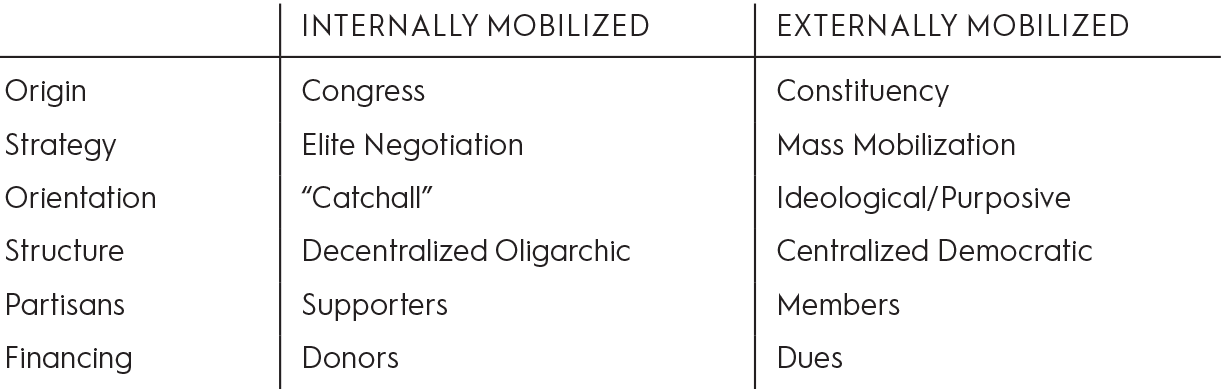
The innovative techniques employed by mass parties had far-reaching consequences. Figure 1 compares the differences between internally mobilized parties — those founded within the halls of power and by elite political insiders — and mass, externally mobilized parties. First, the advent of membership-driven financing ensured the party was primarily beholden to its members and not to a donor class. Second, the institutionalization of a party program helped not only to attract voters but inspired members to see beyond the short-term electoral failures of any given politician. A coherent ideological vision helped ensure partisans’ commitment to the party, and the program allowed members to judge how faithful their candidates had been to the party’s goals. This, in turn, facilitated party leaders’ responsiveness and accountability to rank-and-file membership.
Finally, the internal governance and structure of mass parties was unlike anything developed by internally mobilized parties. Elite parties treated partisans as “supporters” with few obligations or responsibilities to the party. In turn, the party did not expect much of the partisans, and voters were free to choose among a bevy of political options the way the consumer is free to spend her money in the market. By contrast, mass workers’ parties were highly organized membership associations. Members were not only expected to pay dues, but they also had party responsibilities and were expected to participate in the daily life of the organization.
Candidates of these parties had strong incentives to cleave to the members’ interests, since the latter were the campaign workers responsible for getting candidates elected, and they provided the lion’s share of campaigns’ financial resources.6 Political opportunism came at the cost of potentially weakening the mobilization machine, both in terms of alienating frustrated members and muddying the party’s organizational and ideological coherence. Further, by giving members a meaningful stake in organizational decision-making, the party structure provided members a vibrant internal culture that built their identification with the organization and their class, and that limited the risk that members might abandon the party during (inevitable) periods of low electoral success. Such a structure also helped sharpen the ideological orientation of the party through constant programmatic debate tested against the real force of democratic electoral competition.
A mass political organization like those described above is not simply one avenue for left-wing electoral action; it is a necessary condition for success. Because parties of the Left and labor have fewer resources, they have to rely largely on the strength of their numbers and superior organization to make an impact. The innovations developed by externally mobilized parties help them overcome a number of obstacles presented by both hostile political systems and rival parties. The pooling of finances, the organization and mobilization of voters as members, the programmatic appeals, and their internal democratic structure all play a role in increasing their electoral competitiveness. As explosive as individual left-wing candidates may be, and as popular as socialist demands might be in the abstract, there is simply no substitute for a permanent structure that can mobilize members, organize political claims, and discipline party candidates.
It is perhaps not a coincidence that the retreat of social democracy and the onset of neoliberalism coincided with the crippling and erosion of the historic workers’ parties in Europe and Latin America. And, as Peter Mair has shown, since at least the 1970s, and accelerating in the 1990s, we have seen a “hollowing” of mass parties.7 This hollowing refers to both the retreat in the demands of the traditional social-democratic parties — their inability to distinguish themselves from other major parties — and the diminishing size of these parties themselves. For instance, Germany’s Social Democratic party, once the pride of the world socialist movement, has witnessed a major decline in the percentage of its overall vote share, and an even more dramatic decline in the size of its dues-paying membership.8 By the 1990s, the parties of social democracy no longer looked like externally mobilized weapons bludgeoning their way into hostile political systems. Instead they morphed into establishment parties brokering their way into government, offering modest reforms, and limiting popular participation.
Of course, some might argue that the collapse of the mass parties in Europe and elsewhere portends the end of party politics altogether, or that the historic failure of social democracy was a function of the organizational form itself. But the demise of the workers’ parties was not related to their commitment to a particularly stultifying party form. In fact, it was the abandonment of mass mobilization as a political strategy, the retreat of their political demands, and the increasingly oligarchic leadership structures that led to their hollowing and collapse. Nonetheless, these parties remain the single greatest weapons the working class has ever produced. Instead of seeking salvation in new forms of political organization, it seems that any contemporary political organization of the Left and labor would need to replicate the techniques and strategies employed by externally mobilized workers’ parties.
The decline of mass parties of the Left everywhere demonstrates the challenge of maintaining these organizations. The urgency of democratic competition, and of managing the capitalist economy, can compel any such organization to favor short-term transactional goals over the long-term party program. Leaders often seek to consolidate their power through bureaucracy, and the rise of a particularly charismatic figure can destabilize the internal life of such an organization. Yet such liabilities are always present in politics, and however imperfect they may be, the mass parties described above remain the only bulwark against such machinations. But building such an organization is no easy task. We now turn to the key constraints that complicate this work in the United States today.
Challenges to Party Formation: State, Party, and Money
Democratic socialists around the world are confronted by a range of constraints that limit the development and success of mass left-wing parties. Consider that everywhere the outsize resources of business interests affords them unparalleled political advantages.9 Further, the structure of capitalist democracies — dependent on taxation from income-generating enterprises — limits even the most successful reform efforts.10 Beyond this, politicians in all contexts tend to focus above all on getting elected and staying in office.11 As a result, the imperatives of democratic party competition and the management of a capitalist economy generally create incentives for politicians to take a transactional approach to politics that undermines their commitment to particular ideological or policy positions.12 These challenges are present even in the political contexts most conducive to socialist politics. In the US context, however, democratic socialists must also overcome a host of uniquely American challenges.
The United States’ labyrinthine decentralized and semi-democratic political system has facilitated the growth of a unique form of party duopoly. What’s more, the structure of the major parties, and the Democratic Party in particular, along with the enormous influence of money in US politics — unparalleled in the world — puts American socialists at a distinct disadvantage.
The Anti-Party State
Most observers of party politics in the United States will notice the peculiarity of the system. As E. E. Schattschneider rightly noted more than four decades ago, barriers to participation and the structure of “the most complex governmental system in the world” are sufficient grounds for questioning the “sovereignty” of the American voter.13 For our purposes, it is important to explore how the political system of the United States punishes any political opposition. What is perhaps most surprising about the system is that it was not built with the intention of stifling socialist agitation in particular, like the German Anti-Socialist laws (1878–88), but that its structure was designed to frustrate the existence of any party organizations, let alone mass workers’ parties.
Our highly unrepresentative “winner take all” single-member district electoral system was designed for individuals and not parties. In fact, factions and parties are quite clearly discouraged by the US Constitution. James Madison hoped to diffuse the possibility of party formation through a maze-like division of powers and the sheer magnitude of elected offices.14 So great was Madison’s fear of the formation of a “majority faction” that he claimed “the great object” of the American form of government was “to secure the public good and private rights against the danger of such a faction.” His aim was to rid government of the “disease” of factionalism and the very possibility of party government — that is, a government ruled by a majority party.15
Nonetheless, real parties emerged by 1828 and matured in the Jacksonian era. And while the rules set forward in the Constitution were unable to stop the emergence of parties, they produced a strong tendency toward duopoly. In order to win, in each of the legislative districts that make up the electoral geography of the United States, a party must obtain a plurality of votes in the district. The victor then monopolizes political power in the entire district, even if they only win 30 percent of the vote. These zero-sum electoral contests mean that small differences in a candidate’s vote share can have profound political consequences.
The implications are obvious. Because the loser of a given election wins zero seats (regardless of their electoral strength), smaller parties have an incentive to band together with larger parties to build majority coalitions. Failing to do this not only guarantees their own electoral defeat but also takes votes away from larger parties with which they are most closely aligned politically. Candidates, for their part, are unlikely to accept recruitment to minor-party tickets out of a justifiable fear that doing so will doom their electoral viability. Finally, voters are unlikely to cast ballots for third-party candidates out of a reasonable concern that this will contribute to a “spoiler” effect in which voting for a third-party candidate increases the chances of electing the candidate furthest from their own political perspective.16
To demonstrate how unrepresentative this system can be, consider that there is no way of knowing a priori how many seats a given party will win in the legislature based on the percentage of the total votes that party obtains. A party in the United States can win 60 percent of the total votes nationally and know nothing about how many seats it will capture in Congress. What matters chiefly is the distribution of votes across the districts. Thus, the Republican Party captured 12 million fewer votes than the Democratic Party in Senate races across the country in 2018 but wound up with a majority.17
Direct election of the president only compounds these problems. In “presidentialist” systems, parties have strong incentives to appeal to the broadest possible electoral base in order to win, rather than cultivate strong partisan ties around a clear and coherent political program.18 This, too, helps cleave the electorate into two great camps that encompass a broad array of ideological positions and class interests. Presidentialism also increases the candidate-centric nature of partisan politics. Further, given that presidential elections occur concurrently with both national legislative elections and a range of state- and local-level elections, lower-level party officials and office seekers also have strong incentives to ally themselves with leading party candidates to reap the benefits of presidential coattails (more on this below).19
Another obstacle facing third parties is the US system’s combination of presidentialism with first-past-the-post electoral rules. Under these conditions, the chance that third parties can compete effectively in the legislature diminishes considerably compared with mixed presidential/proportional representation systems — as in much of Latin America, where presidential systems often feature multiple parties in the legislature. In presidential systems that use proportional representation rather than first-past-the-post electoral rules, candidates seeking legislative offices have weaker incentives to hitch their electoral wagons to a party of one of the major presidential candidates, since they can still return members to the legislature even with a small share of the national vote.20 As an example, take Brazil, which almost always features only two competitive candidates for the presidency, but whose national legislature currently has members from more than two dozen political parties.
Finally, consider, as Ackerman shows, the multitude of obstacles minor parties must overcome simply to appear on the ballot.21 Ackerman recognizes that the US government is not simply manipulated by private political parties, but rather that the state and party are now so intertwined that it is sometimes hard to find where government ends and parties begin. Consider that when one “joins” an American party, they do so by registering with the state, not with the party itself. This, combined with all the other challenges baked into the political system discussed above, is precisely why Ackerman and others advocate that political insurgents “rent” the Democratic Party ballot line. Indeed, there is nothing preventing socialist candidates from running as Democrats, and the solution provides an elegant and effective means for socialists to compete with major-party candidates. The ballot-line solution also does not preclude the formation of a mass membership organization that operates much like a party and mobilizes members in precisely the way mass parties are expected to, just as Ackerman argues. However, while renting the ballot line does provide a solution to many of the challenges described above, the tactic alone does not offer us a strategic orientation for overcoming obstacles to building a mass constituency for a left-wing party-surrogate, nor does it help us understand how socialists should engage with the Democratic Party itself.
The Structure of the Democratic Party
The Democratic Party is a famously diffuse and porous organization that offers a range of opportunities for left-wing challengers seeking to gain a foothold within it. At the same time, it is important not to exaggerate the party’s “nonparty” character. In fact, the party’s structure and internal procedures are remarkably effective in limiting candidates’ autonomy and hindering progressive efforts at party takeover.
Beyond the party’s open primary system, which offers left-wing challengers an opportunity to run on the Democratic Party ballot line, the other key factor that makes the party vulnerable to left entry is its remarkable level of decentralization. Its subnational organizations are largely independent politically and financially; state- and municipal-level party organizations are free to pick and choose their own local candidates and even their own political program. However, while the local nature of the “low party” has some advantages that increase its vulnerability, there are also powerful headwinds that effectively negate the possibilities for party capture discussed above.
First, the party doesn’t hold direct elections to select its highest officers. This is in stark contrast to most parties of the Left and labor around the world. Consider that in order to win the leadership of the UK Labour Party, one of the most centralized parties in the world, a member need only be nominated by 10 percent of elected Parliamentary Labour Party members and win a majority of votes by preferential ballot in a one-person, one-vote system.22 If elected, she serves as prime minister; if not, she serves as opposition leader, but in either outcome, she appoints her cabinet or shadow cabinet, who stand as the party’s senior leadership.
Who, then, leads the Democratic Party? When the party controls the executive branch, naturally the president is the party leader. But when the party does not control the executive, party leadership falls to the most senior legislative party member. When the party controls the House but not the Senate, this is the Speaker of the House; when the party controls the Senate but not the House, it is the Senate Majority Leader; when the party controls neither the House, the Senate, nor the executive branch, the party is led by its minority leaders.23 Notice, however, that these positions are not “party positions” elected by all party members. Indeed, the path to becoming Speaker of the House involves first winning an election in-district, then winning a party majority in Congress, and only then winning an election among party-caucus members. The party’s highest officers, then, are not elected by the party’s members (with the indirect exception of the president) but instead by their colleagues in the legislature. The election is a ratification of the candidate’s ascension to leadership rather than its mechanism. The whole affair is several steps removed from the rank-and-file party members.
It’s difficult to exaggerate how oligarchic and impenetrable this structure can be. Consider, again, the contrast with a more democratic and centralized party. In Jeremy Corbyn’s bid for the Labour Party leadership, he insisted that a new direction was needed in order to win government, he organized his supporters around the claim that Labour needed a left turn, the insurgency overwhelmed the leadership election with the help of the pressure group Momentum, and Corbyn campaigned for Labour in his proposed direction. In the United States, the process is almost entirely reversed; a party politician must win government first in order to effectively lead their party. For instance, Nancy Pelosi, Speaker of the House and the most senior leader of the Democratic Party, assumed party leadership after the Democrats took control of the House in 2018. Her election as speaker had little to do with any debate within the party membership and was confined exclusively to Democratic Caucus members in the House. Worse, if Democrats are unhappy with her leadership, they cannot collectively organize to “deselect” or replace her, as Labour Party members can. Instead, a candidate must primary her in her district, and only constituents within that district may participate in the election. Finally, removing Pelosi from her position would not mean a democratization of leadership selection, since her successor would still be chosen by the Democratic Caucus in Congress.
In addition to the impenetrability of party leadership selection, over the past several decades the party has undergone a marked increase in internal discipline that has hindered the attempts of progressives to stake out an independent policy agenda. Historically, observers have insisted that the major parties are something like containers for pluralism, as divided, fractured, and decentralized as the American government itself. While this was always something of a fantasy, over the past forty years or so, a major change in the party system has resulted in the hyperconcentration of power in the hands of party and economic elites. This has resulted in increased party discipline, which in turn has dramatically raised the cost of internal party dissent.
The Collapse of the Machines and the Rise of the Presidency
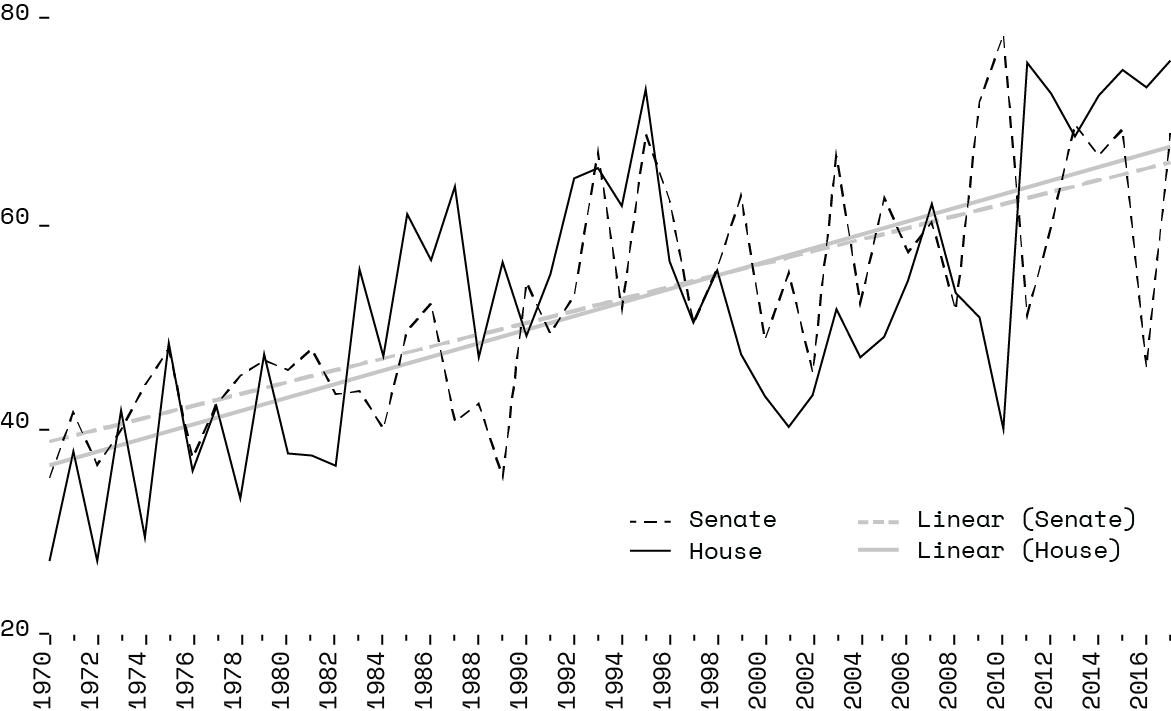
Perhaps the most striking change in the party system in the postwar era has been the near total disappearance of the political machine and the concentration of party power around the president. The collapse of the machine has been well documented and largely celebrated as a genuine step forward for democracy. Mid-century observers argued that, should the power of the local bosses and political machines be eroded, we would witness the centralization and “responsibilization” of the Democratic Party.24 In other words, political machines were thought to be the primary obstacle preventing American parties from becoming ideological parties that would be responsible to their party memberships. This was partially correct. The collapse of machines has led to something like a pseudo-centralization of the party. The evidence of this is the remarkable rise of party unity across both legislative houses over the past fifty years. One can no longer entertain the notion that political parties are hopelessly fractured and endlessly pluralistic. Figure 2 shows the increase in “party unity” votes — votes wherein the majority of party members in Congress vote together. Before 1970, less than 40 percent of votes in Congress were party-line votes; by 1990, more than half of all votes were; by 2010, party unity votes surpassed 60 percent and are set to surpass 70 percent in the next two years. This is something of a puzzle. The Democratic Party remains a highly decentralized and ideologically diverse organization, yet the sudden and remarkable rise of party unity seems to suggest the opposite — that the party has become responsible, ideological, and purposive.
Figure 2
Party Unity Votes in Both Legislative Houses (1970–2016)
Note: Authors’ elaboration. Data from Rollcall.com.
What explains the rise in party discipline at the congressional level if we have not seen a concomitant democratization and centralization of the party? In fact, the appearance of centralization obscures two developments: (1) the rise of the presidency, as a substitute for party politics, and (2) the increase in the influence of money.
In their attempt to attack the patronage system of centralized machines like Tammany Hall, New Dealers set about institutionalizing the power of the executive branch in domestic policy, chiefly through the Reorganization Act of 1939. Martin Shefter describes the sweeping changes as follows:
The Reorganization Act would expand the White House staff; extend the merit system and replace the Civil Service Commission with a single personnel director appointed by the president; transfer the pre-auditing function from the Comptroller-General (and the Congress) to the Budget Bureau (and the President); create a central planning agency in the Executive Office; and place all administrative agencies, including the independent regulatory commissions under one of the cabinet departments.25
These changes effectively allowed Franklin D. Roosevelt and his allies to usurp power from the local party machines and party bosses hostile to his reform agenda in major Democratic cities. The New Deal reforms were not an immediate death sentence for the urban machines. Notably, Roosevelt allowed the spoils and patronage systems to persist wherever a Democratic machine was friendly to his administration (like in Chicago), and he starved those that were hostile (like in New York). But, perhaps more importantly, New Deal liberals relied on a strategy of mass mobilization, much like the mass workers’ parties in Europe. As such, Roosevelt needed machines in much the same way he needed industrial unions: such organizations provided a well-organized voter mobilization apparatus.
However, as subsequent administrations discovered the vastly expanded powers of the executive branch, they found little need for the maintenance of political machines that often proved a liability for their political aims. The rise of the primary system is further evidence of the shift away from political machines. John F. Kennedy was among the first to eschew the machines and make serious use of the primaries in his 1960 campaign. The primary system would soon become the norm for electing candidates in almost all state parties. By the time of the New Politics reform movement of the late 1960s, the only remaining political machine of any import was in Chicago, and it, too, would soon collapse. The presidency, and electoral contests to control it, replaced the machines as both the singular programmatic force of the party and the major avenue of voter mobilization.
As patronage dried up, local party organizations were hollowed out. And without urban machines, candidates could no longer rely on a mobilization arm in the cities. As a result, the strategy for party candidates vying for office changed. Hitching their political careers to higher-office party leaders, and especially to the presidential candidate of the party, offered a number of advantages. By aligning with the party’s presidential candidate (or likely presidential candidate), a candidate could reasonably expect to reap the benefits of riding his or her coattails, and if successful, loyalty would be rewarded by securing important committee seats in the legislature or cabinet. This shift in party power — from machines to leadership — partially explains the tendency toward party unity. Candidates and legislators recognized the advantages that come with loyalty to the leadership, and they also noticed the costs of dissent. Party leaders in Congress began employing a number of techniques to ensure unity around presidential issues and to discipline dissenting members.26 The decline of minority-party participation in legislating, the disappearance of the conference committee, and the selective restriction of information to legislators by party leaders all demonstrate a tendency toward oligarchic centralization, a tendency that was once checked by the presence — however ignoble — of urban machines.
The collapse of the machines does present a unique opportunity for the Left and labor — without local party organizations, an organization of the Left has little competition on the ground for voter mobilization efforts, as we will explore below. Nonetheless, as we have seen, the oligarchic centralization of the party structure poses barriers for party “takeover” or realignment. For instance, as the party concentrates power at the top, insurgent candidates interested in reform must resist the incentives that come from aligning with party leadership, and without party machines, they must build their own mobilization operations without the support of (and often with resistance from) the national party.
The Power of Money
The structural changes wrought by the mid-century reorganization of party politics triggered another shift: the rise of organized money. As urban machines folded up their voter mobilization operations, candidates realized the only replacement for mass mobilization was cash. And by the mid-1970s, reforms to campaign finance laws paved the way for a fundraising operation that offers wealthy donors inordinate influence in determining candidate viability and serves as the first line of defense against electoral insurgency.
Campaign finance has always been a major impediment for the Left in the United States. In fact, the first candidate to use organized cash was Republican William McKinley in his 1896 effort to defeat left-wing populist Democrat William Jennings Bryan.27 But today, campaign cash plays a far greater role in American politics than it ever has, and its influence is only increasing. The rise of campaign contributions in sheer dollar amounts, combined with the concentration and organization of money by the major parties, has had a considerable disciplining effect on candidates.
In 2012, the share of total campaign contributions from the top 0.01 percent of income-earners was over 40 percent, up from around 15 percent in 1980.28 This increase is driven less by changes in campaign finance laws (which have been very favorable to high-income donors since the Supreme Court’s 1976 Buckley decision) and more by the rising wealth of the superrich. The wealthiest donors in the 1980 federal election contributed $1.72 million, which, at the time, was a huge outlier. Compare this to the 2012 elections, in which the two largest donors (Sheldon and Miriam Adelson) gave $56.8 million and $46.6 million respectively. Not surprisingly, then, the reliance of both major political parties on top donors has increased dramatically over the past thirty-five years.29 Worse, relative contribution levels from countervailing organizations like labor unions has declined precipitously.
Given that the proportion of campaign finance coming from the superrich has increased dramatically over the past three decades, and since access to campaign finance plays a critical role in determining a candidate’s viability, the declining proportion of campaign finance available to candidates not supported by the superrich makes their capacity to win elections increasingly slim.30 In other words, it is significantly more difficult today than it was thirty years ago for a candidate without ruling-class sponsors to win elections.
What’s more, the parties themselves have sought to organize and distribute money in these past thirty years so as to better secure majorities and effectively control their incumbents and candidates. As discussed above, without a voter mobilization outfit, candidates found themselves increasingly dependent on cash to get them over the electoral finish line. The collapse of urban machines hit Democrats harder than Republicans, and they were initially the ones who sought to outraise and better organize their fundraising efforts to beat their opponents.
The advent of member-to-member giving, initiated by Lyndon Johnson, allowed candidates with excess campaign funds to transfer their money to those candidates who were cash-strapped.31 By the 1990s, the Democratic Congressional Campaign Committee (DCCC) began to organize the process more formally. They encouraged incumbent members to dump excess campaign funds into the DCCC in an effort to redistribute the funds.32 The goal was twofold. First, by organizing and concentrating money, the party leadership would best determine how to maintain or win a majority. Second, and perhaps more importantly, the party leadership could discipline its congressional members through a carrot-and-stick approach. Giving to the DCCC soon became a mark of party loyalty, and receiving any cash from the committee was dependent on toeing the party line.33
These party funds may not be necessary for candidates who already command impressive fundraising operations, but for cash-poor candidates, those representing poor urban or rural districts, or those with a decidedly redistributive policy agenda (because wealthy donors are less likely to contribute to these candidates’ campaigns), DCCC cash becomes significantly more important.
The rise of party money in particular is demonstrated strikingly in just the last few decades. In 1992, the DCCC spent some $14 million; by 2006, the committee spent $140 million; and by 2018, an unprecedented $297 million.34 Not only does access to campaign finance seriously affect a candidate’s chance of electoral success, but it also severely constrains candidates’ policy objectives by forcing candidates to reflect the interests of their top donors. Thomas Ferguson, for instance, argues that political parties can best be understood “as blocs of major investors who coalesce to advance candidates representing their interests.”35 In Ferguson’s account, the only individuals and groups with sufficient funds to invest significant resources into the political system are the superrich. In turn, these individuals and groups expect significant returns on their investment. As a result, candidates adjust their policy objectives to match those of their most important investors as closely as possible. Ferguson concedes that there are moments when ordinary voters have successfully pooled their resources to become a major collective investor in the Democratic Party (specifically during the 1930s), but such occurrences have been extremely rare and not particularly sustainable.
More recent scholarship supports Ferguson’s hypothesis about the role of economic elites in shaping the decisions of politicians. Gilens and Page, for instance, find the probability that a given policy will reflect the interests of ordinary voters is not affected at all by the amount of support the policy has among ordinary voters.36 By contrast, their results suggest that a policy enjoying low support among economic elites will be adopted 18 percent of the time, while a policy with widespread support among the economic elite will be adopted 45 percent of the time. Of course, it could be the case that the interests of politicians are simply aligned with those of economic elites because politicians themselves are economic elites. Indeed, Carnes has shown that the class background of legislators is significantly correlated with their political preferences.37 Specifically, working-class legislators are consistently more progressive in roll-call voting patterns than legislators from other class backgrounds. Thus, if the number of working-class congresspeople increased dramatically (it is currently around 2 percent in the US House of Representatives, 3 percent in state legislatures, and 9 percent in city councils), the interests of economic elites might not track so closely with the policy objectives of elected officials. However, it is likely that any changes in legislators’ policy objectives caused by this increase in the number of working-class congresspeople would — due to the imperative to maintain the support of key financial backers — be limited at best.
Of course, there are important caveats to raise. The most obvious is the capacity of small-donor online fundraising to seriously threaten the power of entrenched economic elites and the leadership within the Democratic Party, a point made dramatically by the 2016 presidential campaign of Bernie Sanders. The role of money in politics can also be mitigated significantly at the local level, as the electoral effect of having a strong ground game becomes larger relative to the electoral effect of campaign contributions (we discuss this issue in more detail below). The Sanders campaign of 2016, as well as a host of local democratic-socialist electoral victories in 2017 and 2018, are a clear testament to this fact.
The Compounding Effects of Party Structure, Presidentialism, and Money
Insurgents who want to realign the Democratic Party effectively have two options. The first, which we can call “realignment from below,” would involve organized attempts to capture local and state parties in an effort to change party rules in favor of cash-poor candidates. The idea here is that by taking over local and state parties, realigners could lower the barriers to entry for outsider candidates. Theoretically, of course, this is possible. However, given the financial and organizational weakness of these local and state parties, any advantages won by a liberalization of party rules would be neutralized by the fundraising power of big donors or the DCCC. In other words, even if realigners succeeded in capturing a local party, the insurgent outsider candidates they intend to help would still find themselves competing with better-financed establishment rivals in Democratic Party primaries.
Another realignment strategy might be called “realignment from above.” This would involve challenging the party leadership directly through the presidential primary system. A good example of such an attempt is Sanders’s 2016 presidential campaigns. Sanders had never attempted to work through the party structures to secure endorsements from party elites or financing from major party donors. As a result, he effectively avoided the moderating effects of the Democratic Party structure. Indeed, his independence was more than a ballot-line decision, it forced him to develop an independent fundraising infrastructure and mobilization machine. Consider that Sanders financed his campaigns almost exclusively through small-dollar donations and union contributions. And in 2016 Bernie took on the party’s leadership directly by going to voters in the presidential primary contests instead of donors in the DCCC. His campaign also demonstrates just how “presidentialized” American politics has become. His run inspired a string of legislative victories, which is yet more evidence of the relative importance of coattail campaigns. Legislative candidates felt confident hitching their wagon to Sanders, adopting his program, and seeking his support precisely because he proved to be a politically viable presidential candidate.
This strategy has paid off in the short term, and repeating it isn’t out of the question. However, success hinges on the singularity of the candidate: their ability to spend a political career resisting the incentives of the major parties, their ability to consistently win reelection, their ability to fundraise from small-dollar donors and labor, and their ability to create a mass electoral movement wholly independent of the Democrats’ voter mobilization machine. This is no mean feat for any candidate. And even then, the strategy depends on energizing potential coattail candidates to run for congressional and down-ballot seats. But without any countervailing forces to ensure these candidates can win reelection if the presidential candidate loses in the general election (or, in the event of victory, after the progressive president leaves office), the existing oligarchic party structure and the need for campaign finance make the prospects of them maintaining a progressive, redistributive, and independent policy profile slim indeed.
The decentralized and duopolistic nature of American politics, combined with the oligarchic nature of the party structure and candidates’ financial dependence on the superrich and party leadership, compound to effectively induce even the most progressive candidates “upward” and rightward — that is, closer to the party leadership and toward the center politically. Enjoying the coattail effect, accessing important committee seats, funding reelection campaigns, and securing resources from the party bureaucracy all but compel candidates to align with party elites and their donors.
In order to mitigate these effects, we need to build an institution capable of fundraising and mobilizing such that it could sufficiently counteract the incentive structure of the Democratic Party. Before we explain how such a party-surrogate could insulate effectively and build a powerful enough constituency to exert political pressure, let’s first examine the opportunities for mass working-class electoral mobilization today.
Opportunities for Party Formation: The Unaligned Working Class and New Organizational Infrastructures
Having analyzed the constraints to party formation and party takeover, we turn to structural opportunities that exist for a left-wing party-surrogate to mobilize a mass base and build a powerful institutional infrastructure. Historically, the rise of competitive outsider parties tends to reflect the emergence of new social cleavages that are not adequately incorporated into the political programs of existing parties. Examples include the emergence of liberal parties, reflecting the intensifying social cleavage between agrarian elites and the emerging liberal bourgeoisie in the late eighteenth and early to mid-nineteenth centuries, and the rise of social-democratic and labor parties later in the nineteenth and early twentieth centuries, reflecting the emerging social cleavage between capital and industrial labor.38 Similarly dramatic changes have also been required to produce major partisan realignments within existing parties, such as realignments of US political parties in the 1860s, 1890s, and 1930s.39 In the absence of profound changes to social cleavage structures, party loyalties are generally too strong to permit partisan realignment.40 Consequently, without the emergence of a new social cleavage, a left-wing party-surrogate is unlikely to succeed in weakening partisan attachments to the Democratic Party. We argue that a new social cleavage has indeed emerged over the past several decades that provides a historic opportunity for voter mobilization of weakly aligned or unaligned voters: the cleavage between insiders and outsiders of the contemporary economy, specifically between downwardly mobile working-class Americans and members of the professional and middle classes.
The Working Class and Professional/Middle-Class Cleavage
As Dani Rodrik explains, the era of global neoliberalism (from roughly the late 1970s to the present) has produced one broad group of winners — what we refer to as the professional/middle class (PMC) — and another, much larger group of losers, what we refer to as the working class:
For those with the skills, capital, and savvy to prosper in the postindustrial age … [there are] inordinate opportunities. Bankers, consultants and engineers [earn] much higher wages … [and enjoy] much greater control over their daily lives … On the other hand, for less skilled workers, service sector jobs [mean] giving up the negotiated benefits of industrial capitalism. The transition to a service economy … [goes] hand in hand with the decline of unions, job protections, and norms of pay equity … So, the postindustrial economy [opens] a new chasm between those with good jobs in services, which [are] stable, high paying, and rewarding, and those with bad jobs, which [are] fleeting, low paying, and unsatisfying.41
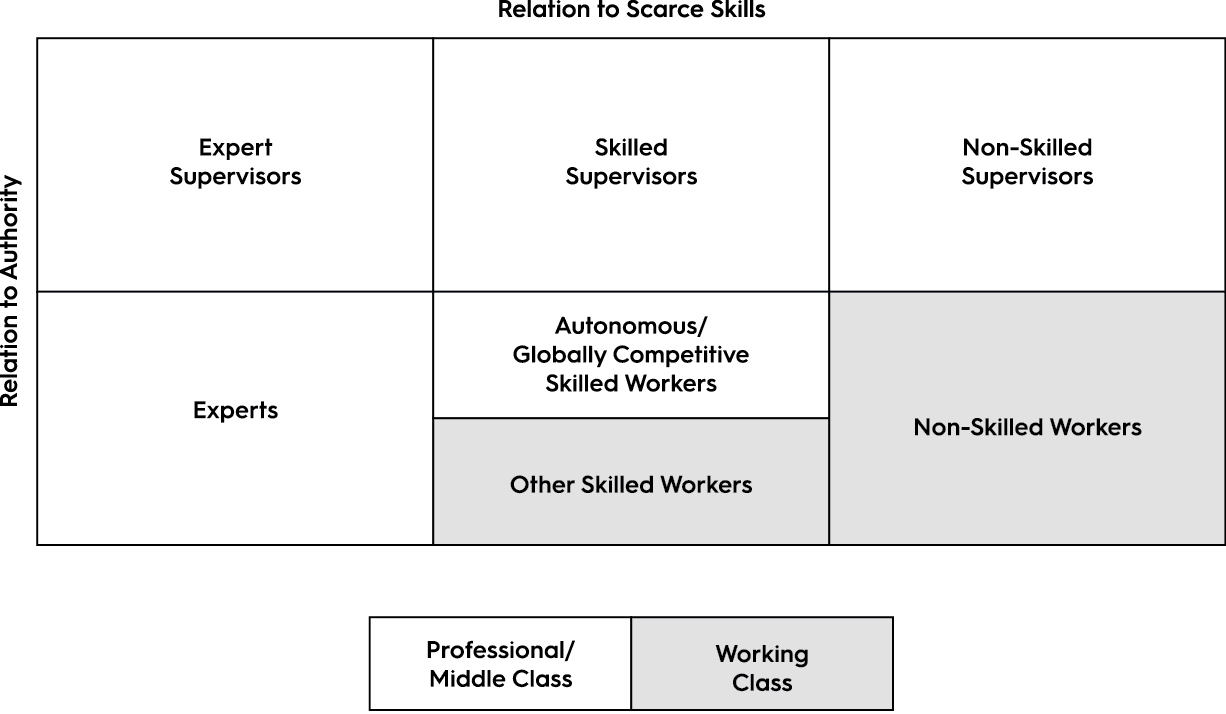
We operationalize the working class and the PMC based on Erik Olin Wright’s typology.42 Wright explains an individual’s class position based on (1) their relationship to the means of production (owner vs. employee), (2) their relative autonomy in the workplace (do they have a supervisor or not?), and (3) the scarce skills they possess (expert, skilled, non-skilled). In this typology, any individual who is neither an owner nor a supervisor is a member of the working class — with the exception of experts who are not supervisors (most university professors, for example). In turn, anyone who is either a supervisor and/or an owner is a member of the middle or capitalist class.
We adopt Wright’s typology with one important exception: we view skilled workers who (a) work under conditions of relative independence, and/or (b) work in industries that are highly valued in the global economy, as members of the PMC. We argue that these workers are more likely than not to benefit, or at least not suffer, from the contemporary global economy. Skilled workers conducting their work under conditions of relative autonomy (such as business consultants and computer programmers) may feel more worried about job security or the threat of their jobs being outsourced or automated than in the past, but in general they have not experienced significant declines in living standards or work conditions over the last several decades. In turn, skilled workers in industries that are highly valued in the global economy may feel a sense of greater job insecurity or increased pressure to perform than in previous decades, but this is offset substantially by the knowledge that unemployment is low in their sector (which makes finding a new, well-paying job relatively easy).
Figure 3: Categorizing Working-Class and Professional/Middle-Class Occupations
Figure 3
Categorizing Working-Class and Professional/Middle-Class Occupations
Note: Adapted from Wright (1997).
Over the past several decades, subjective perceptions of living standards among the working class — critical for voters’ assessments of which political parties and candidates they will support43 — have declined considerably relative to those of the PMC. First, with respect to income, Figure 4 shows that while average working-class incomes have increased since the 1980s (by around 9 percent), average PMC incomes have increased nearly 2.5 times as rapidly (around 23 percent). Further, since there was a significant decline in working-class incomes during the 2000s, the positive relationship between individual incomes and year between 1982 and 2018 is not statistically significant. By contrast, this relationship is statistically significant among the PMC. This suggests that in any given year since 1982, working-class individuals likely did not expect an increase in their income, while members of the PMC did. Finally, the average income gap between the PMC and the working class increased more than 50 percent between 1982 and 2018. As a result, any absolute increase in working-class incomes during this period likely did little to improve working-class perceptions of their standard of living, since they were increasingly modest compared to those enjoyed by the PMC.
Figure 4
Average Working-Class and pmc Incomes, 1982–2018 (in thousands of USD)
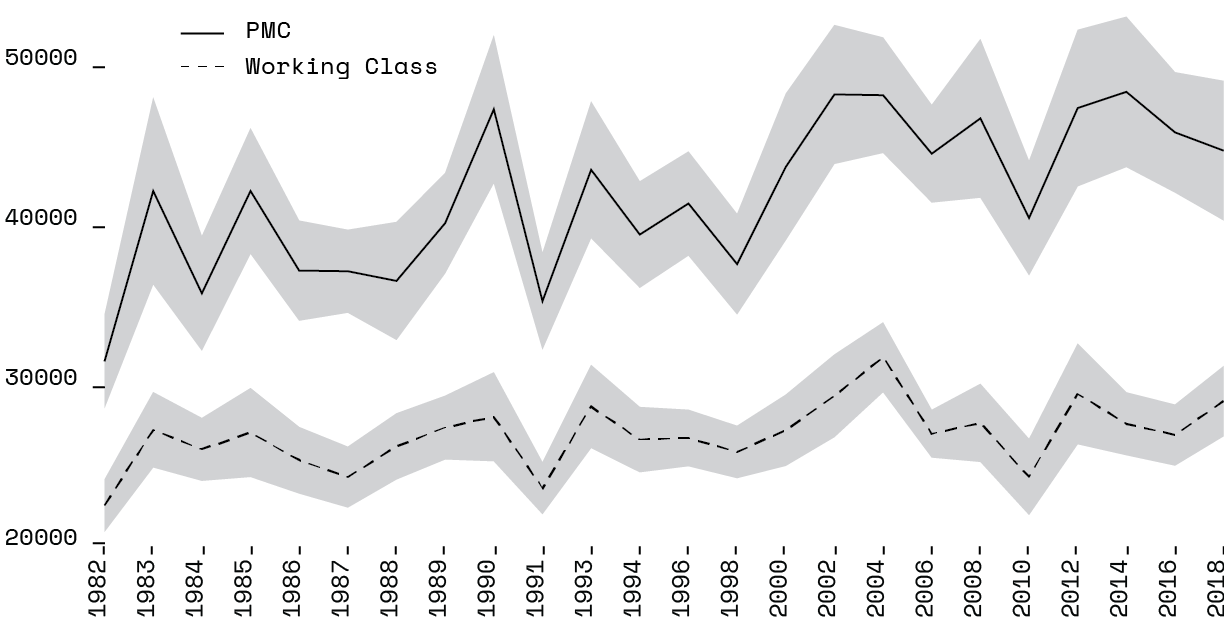
Source: GSS, author’s calculation. Self-reported family incomes adjusted to constant (1986) dollars.
Figure 5
Average Working-Class and PMC Subjective Assessment of Class Position, 1982–2018
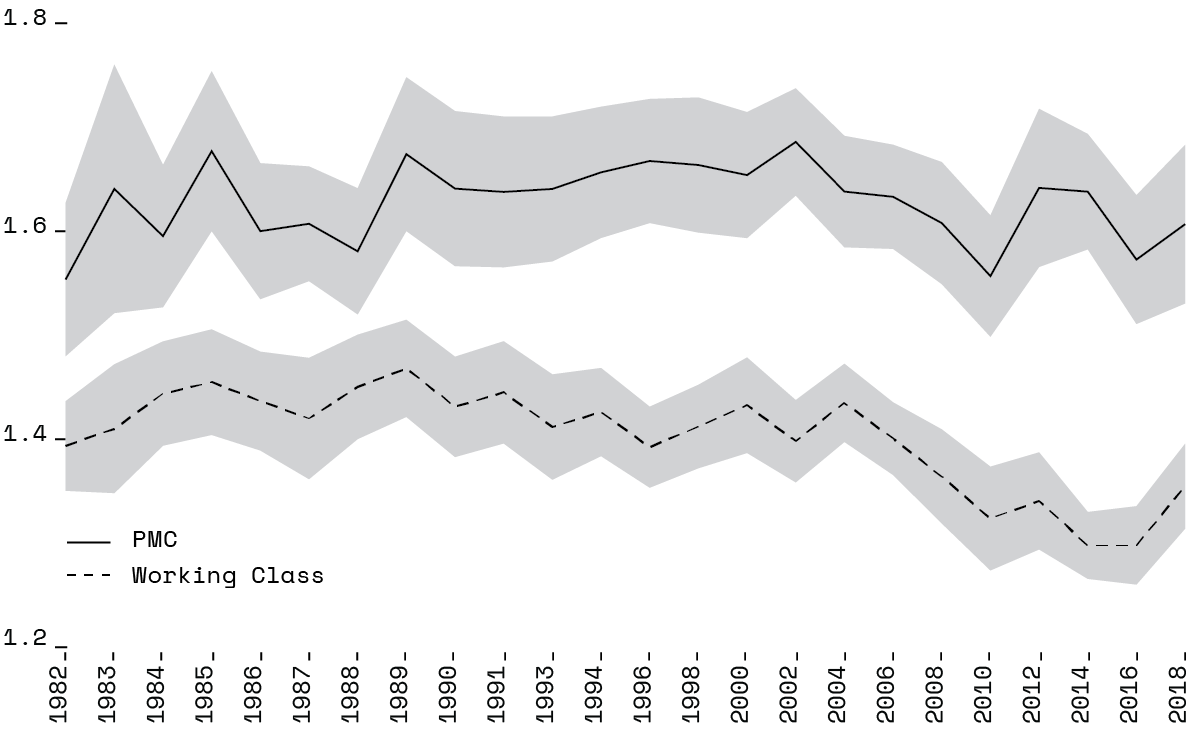
Note: GSS, author’s calculation. Self-reported class identification, scale of 0–3, where 0 = “lower class,” 1 = “working class,” 2 = “middle class,” and 3 = “upper class.”
Figure 6
Average Working-Class and PMC General Happiness, 1982–2018
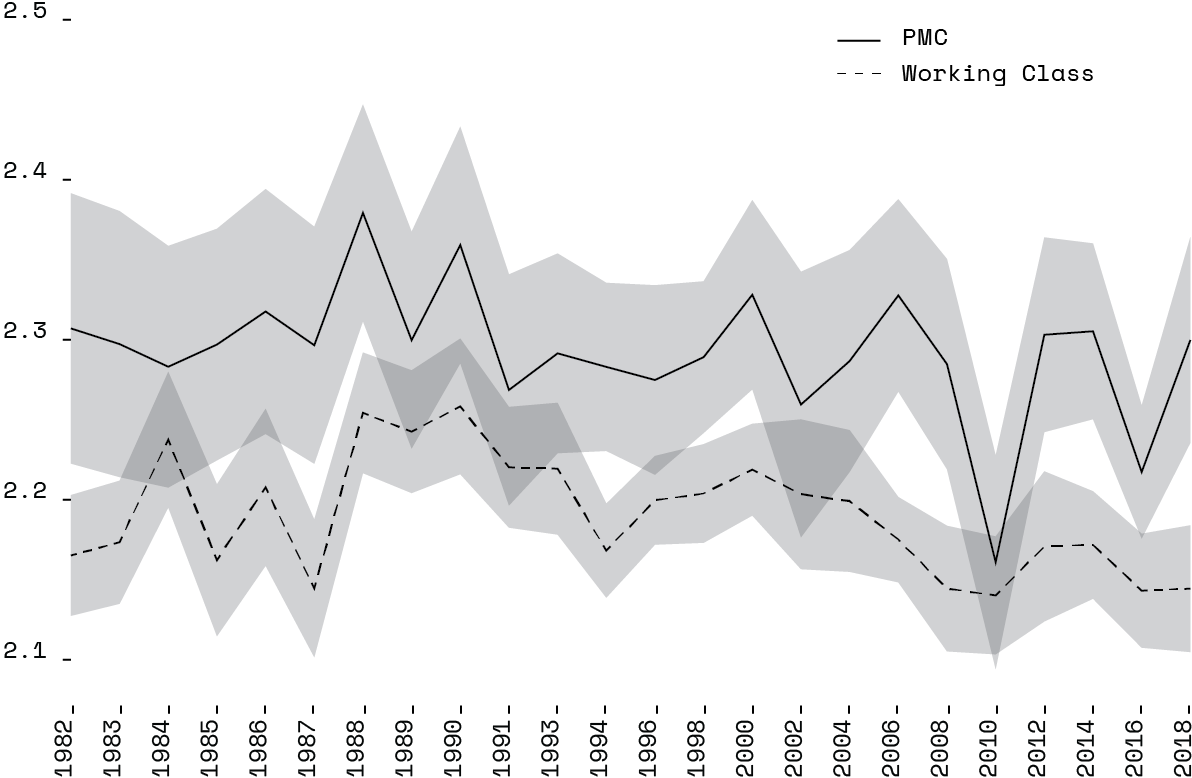
Note: GSS, author’s calculation. Self-reported general happiness, scale of 1–3, where 1 = “not too happy,” 2 = “pretty happy,” and 3 = “very happy.”
Turning to Americans’ subjective assessments of their class position, Figure 5 shows that working-class Americans’ views of their own class standing have become increasingly negative since the 1980s, while those of the PMC have remained largely unchanged. Specifically, there is a statistically significant inverse relationship between subjective assessment of class position and year among the working class, and no significant change in this relationship among the PMC. In turn, the gap between average subjective class position between the working class and the PMC also rose steadily during this period, reaching a high point in 2014. Not only do working-class Americans believe they are downwardly mobile, then, but over time this perception has only become stronger relative to the PMC.
Finally, we see the same divergent trends between the working class and the PMC over the past several decades with respect to Americans’ self-assessments of their general happiness. As Figure 6 shows, after rebounding from a low point during the Reagan years, happiness among the working class steadily declined between 1990 and 2018, with each decade’s average happiness score being lower than that of the previous decade. By contrast, among the PMC, while we do not observe a positive happiness trend over the last several decades, we also do not see a significant decline. Further, the happiness gap between the working class and the PMC increased consistently during this period, and by 2018 was larger than at any other point since 1982.
Democratic Party Electoral Strategy and the Emergence of an Unaligned Working-Class Voter Bloc
As the gap between subjective perceptions of living standards between the working class and the PMC has widened, the Democratic Party has increasingly targeted PMC voters and moved away from its New Deal–era commitment to key social-democratic policies that would disproportionately benefit downwardly mobile working-class voters. From Jimmy Carter to Hillary Clinton, the dominant campaign commitments of presidential candidates (with the partial exception of Obama’s 2012 campaign) have focused on pro-business, fiscally conservative policies, from free trade and financial deregulation to gutting welfare, pursuing Social Security reform, and corporate tax cuts.44 This new policy direction is itself a consequence of the pressures and incentives in the political system described above.45 These include the increasing power of the president and the decline of urban political machines — which in turn kickstarted the centralization of Democratic Party funding operations in the DCCC — as well as politicians’ increasing imperative to hew closely to the policy preferences of high-income donors.
Figure 7
Class Composition of Democratic Party, 1972–2018
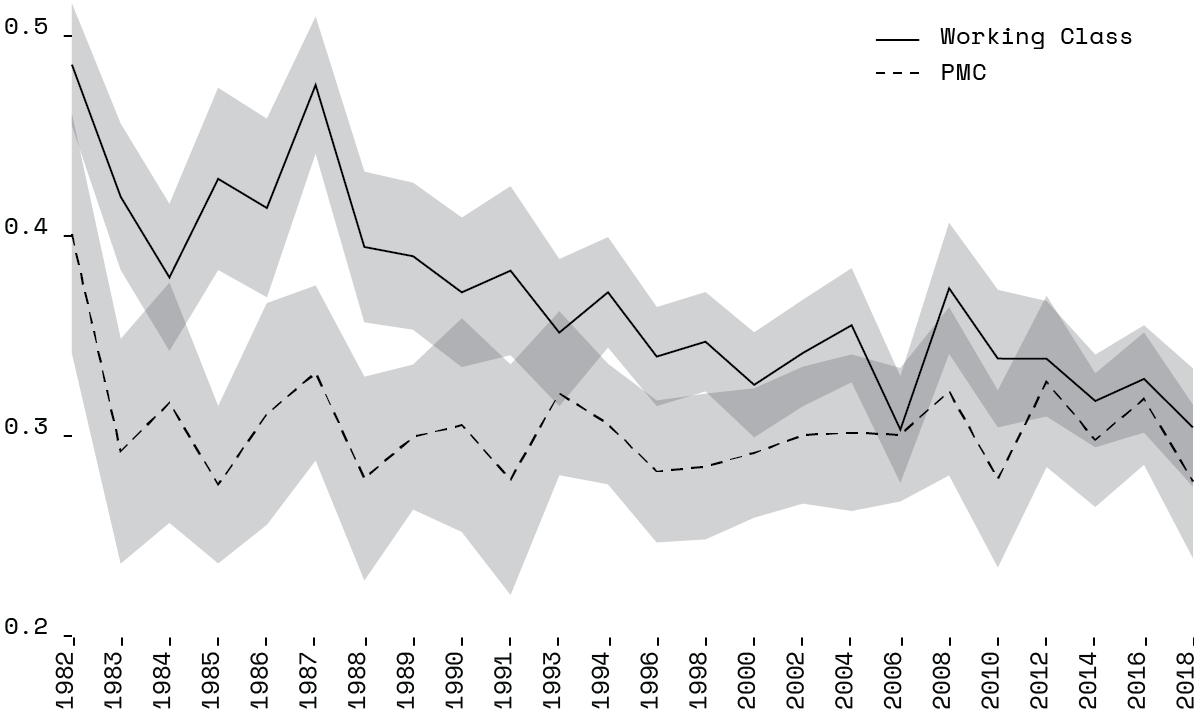
Note: GSS, author’s calculation. Self-reported party affiliation. Respondents could choose among “strong Democrat,” “not strong Democrat,” “independent, near Democratic party,” “independent,” “independent, near Republican party,” “not strong Republican,” “strong Republican,” or “other party.” For Figure 7, we constructed a binary variable where 1 = “strong Democrat,” “not strong Democrat,” or “independent, near “Democratic Party,” and 0 = all other responses.
The increasing gap between the Democratic Party’s priorities and policies capable of reversing decreasing living standards among the working class has been accompanied by a progressive abandonment of the Democratic Party by the working class. No similar abandonment occurred among the PMC, whose policy preferences are more closely aligned with the Democratic Party. These trends are reflected in Figure 7, which shows that as much as 50 percent of the working class identified with the Democratic Party in the 1970s, but that by 2018 this figure had declined to less than 30 percent. By contrast, after a slight decline between the 1980s and 1990s, each decade after the 1990s has seen an increase in the rate of PMC identification with the Democratic Party.
Figure 8
Working-Class Racial Composition, 1982–2018
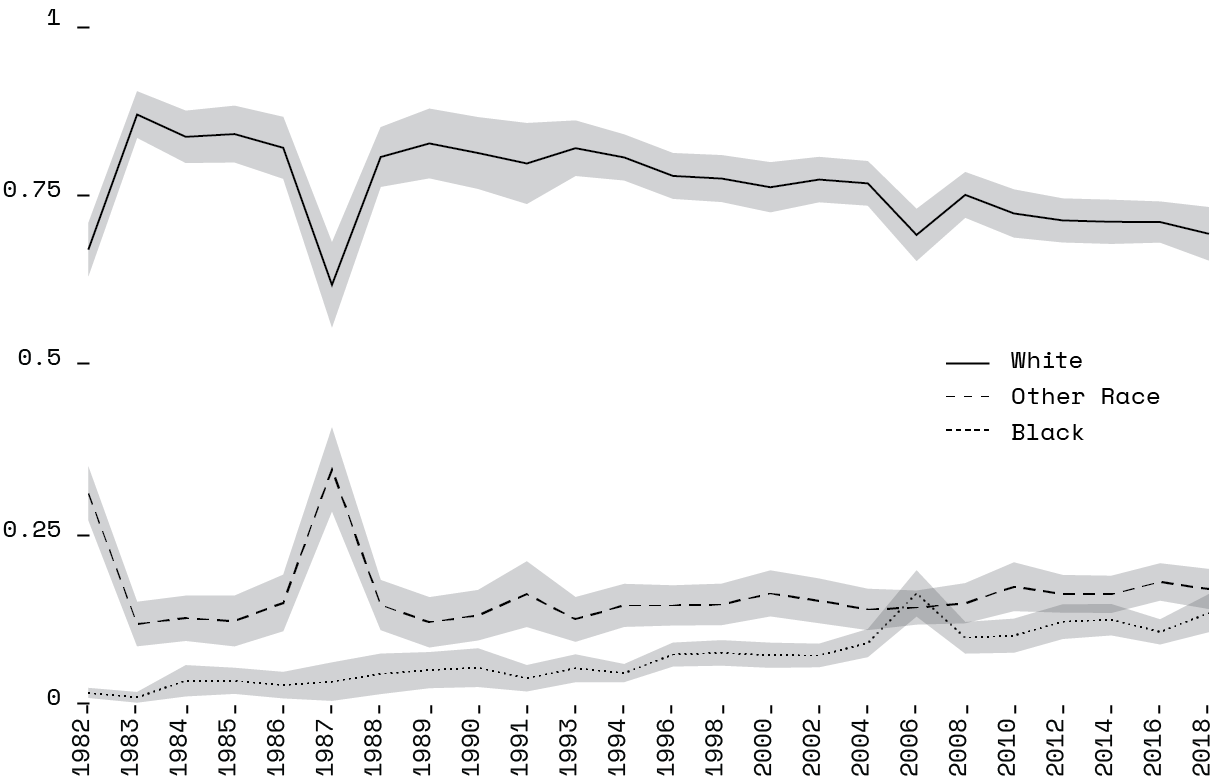
Note: GSS, authors’ calculation. Self-reported racial identification.
Figure 9
Racial Composition of Working-Class Democrats, 1982–2018
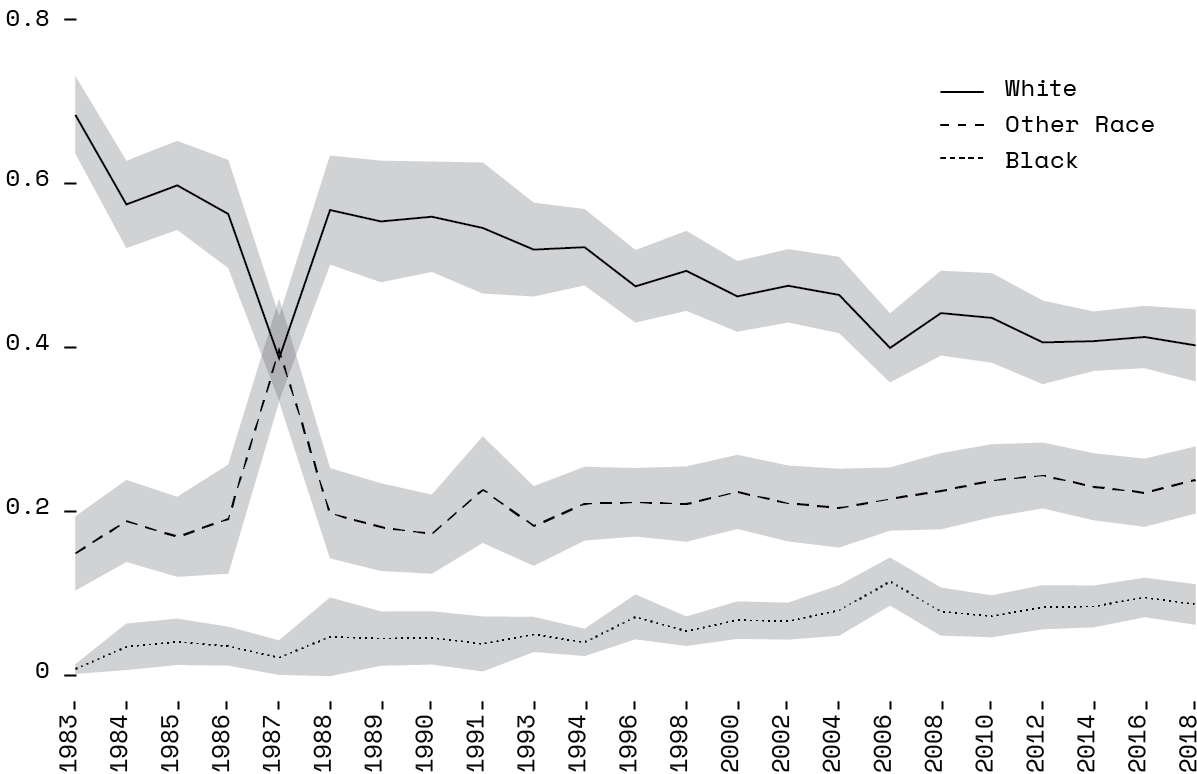
Note: GSS, authors’ calculation.
Of course, it may be the case, as many scholars have argued,46 that this demographic shift in the Democratic Party was primarily a response to the party’s increasing focus on identity-based issues since the 1960s. Indeed, it is true that working-class abandonment of the party preceded the neoliberal restructuring of the last several decades.47 It is also true, as Figures 7 and 8 show, that declining working-class support for the party has been driven primarily by a decline in the proportion of whites among the working class as a whole, as well as defections of working-class white voters from the party. Specifically, the share of working-class whites who identify with the Democratic Party has declined from over 70 percent in 1982 to around 45 percent in 2018. Meanwhile, the share of Democrats from all other racial groups in the working class increased, suggesting that the decline in working-class membership in the Democratic Party was driven almost entirely by whites. In turn, given that the average rate of decline in party membership among working-class whites was much larger than the decline in this group’s share of the working class as a whole, there must be additional factors driving the decline in working-class party membership beyond the shrinking proportion of whites among the working class.
Figure 10
Partisan Composition of The Working-Class, 1974–2018
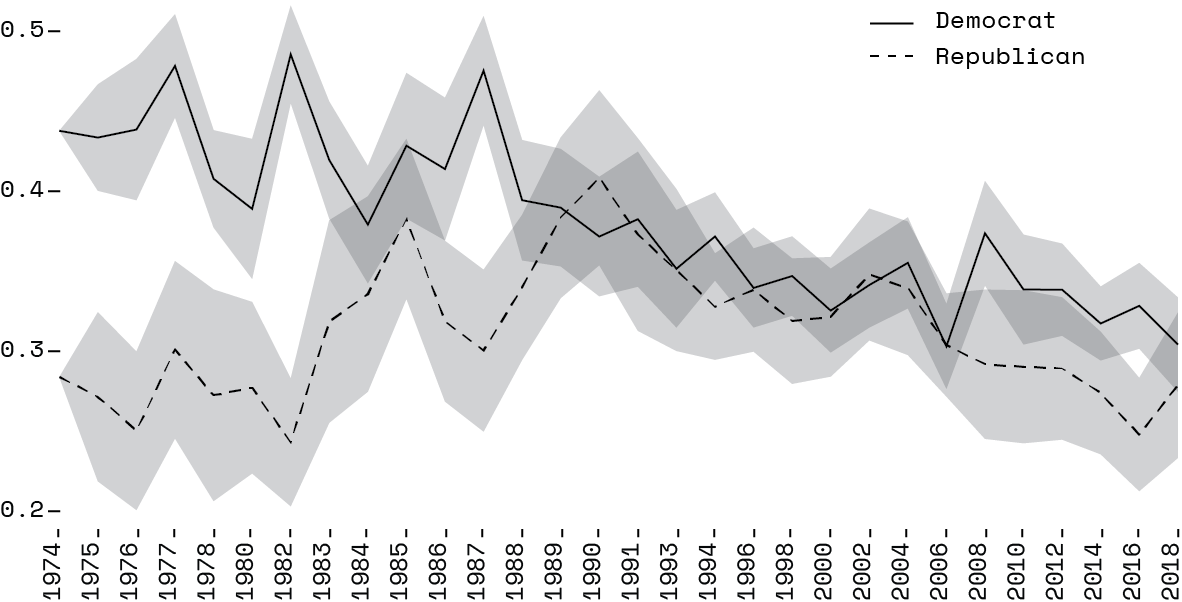
Note: GSS, authors’ calculation.
Figure 11
Partisan Leanings of Independent Voters, 1982–2018
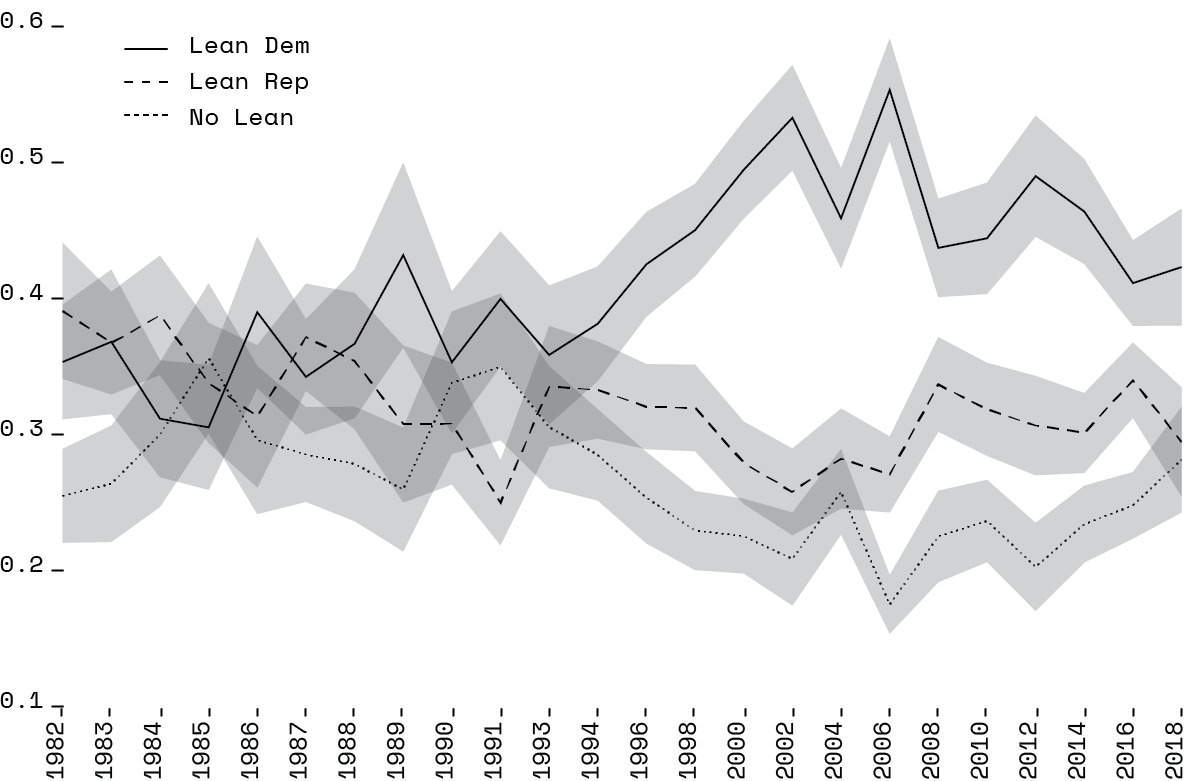
Note: GSS, authors’ calculation. Self-reported racial identification. Respondents could choose between “strong Democrat,” “not strong Democrat,” “independent, near Democratic Party,” “independent,” “independent, near Republican Party,” “not strong Republican,” “strong Republican,” or “other party.” For Figure 11, we constructed a binary variable for each series where “near Republican Party = “Lean Rep,” “near Democratic Party” = “Lean Dem,” and “independent = “no lean.”
If it were true that identity-based resentment drove these defections, however, we would expect that as working-class whites defected from the Democratic Party, there would be a corresponding increase in working-class support for the Republican Party, which could comfortably accommodate the socially conservative values of Democratic defectors.48 As Figure 10 shows, this narrative is partially consistent with trends in partisan affiliation until the 1980s. In subsequent decades, however, decreasing support for the Democratic Party was accompanied by a simultaneous decrease in support for the Republican Party. It may be that working-class voters who abandoned the Democratic Party after 1990 were fiscally conservative advocates of small government who would not find a left-wing party-surrogate appealing. This possibility is largely belied by the fact, shown in Figure 11, that while independents are an ideologically diverse group, less than 30 percent of them lean Republican. Further, GSS data suggest that independent voters who do not lean toward either major party are overwhelming working class (nearly 80 percent), tend to self-identify as politically moderate, and, on average, support government intervention to reduce inequality. In other words, in general, defectors from the Democratic Party are neither particularly opposed to the party’s stance on social issues (or they would have switched to the Republican Party), nor are they too libertarian for the Republican Party.
While we cannot be certain, a likely alternative hypothesis to explain working-class abandonment of the Democratic Party is that many independent voters feel neither major party represents their core political and economic interests. If this is true, many of these voters would likely be attracted to a political platform focused on broad working-class demands that could stem the tide of decades of declining living standards. Given their disillusionment with politics as usual, these voters would find an externally mobilized party-surrogate particularly appealing. The party-surrogate would not only prioritize key policy items important to working-class voters that Democrats have largely ignored, but would also stress the importance of internal democracy and party transparency as a means of credibly committing to working-class voters that the party-surrogate would be structurally constrained in its capacity to sacrifice their interests for the sake of political expediency.
Figure 12
Class Composition of Independents without Partisan Leanings, 1982–2018
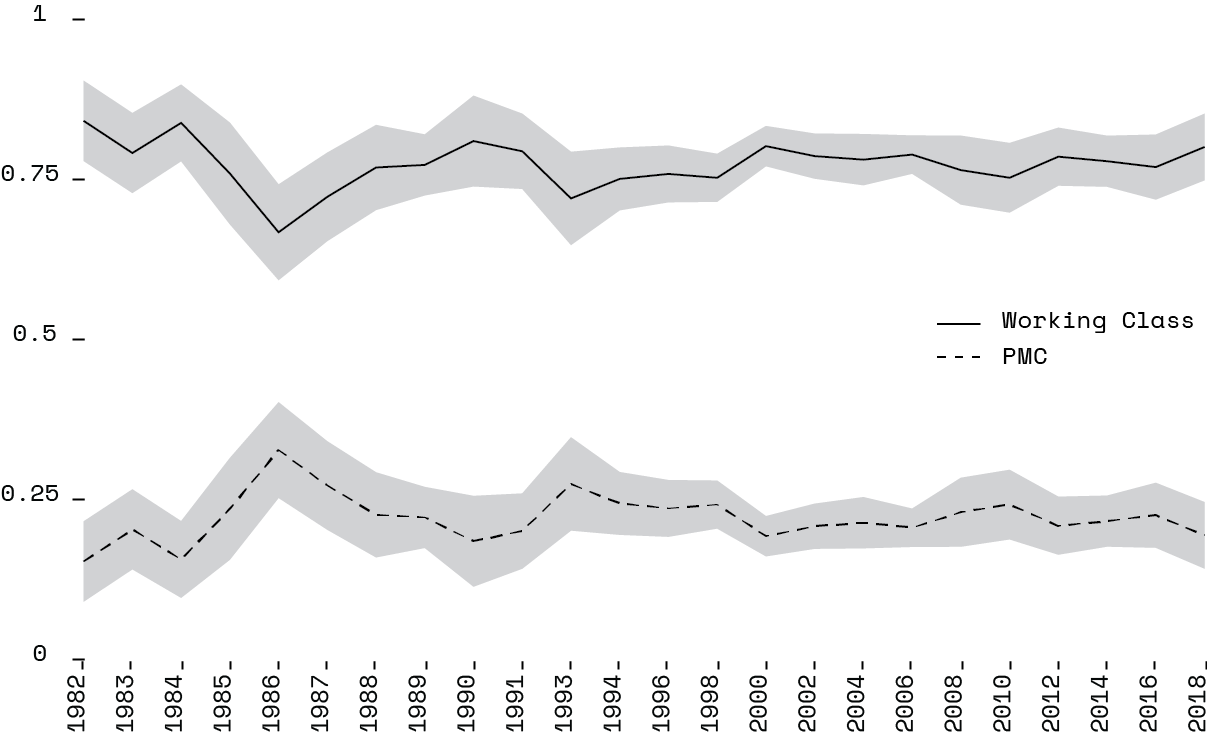
Note: GSS, authors’ calculation.
Not only are many non–Republican-leaning independents potentially open to a left-wing party-surrogate, but as Figure 12 shows, this is a large constituency. Specifically, based on GSS estimates from 2018, roughly 27 percent of Americans both do not identify with either major party and do not lean toward the Republican Party. Since this group is 75 percent working class, we can conclude that roughly 20 percent of Americans are working class, do not identify with either major party, and do not lean Republican. That said, it is possible, as some scholars have argued, that these are independents in name only, and that they actually vote consistently for one of the two major political parties.49 Beyond the fact that more than 40 percent of them report not leaning toward either party — making them potentially receptive to challenger appeals even if they have voted consistently for one party in the past for strategic reasons — much of this group simply does not vote. According to the GSS, for example, approximately half of working-class independents in 2016 and 2018 reported not having voted in recent presidential elections (compared to under 20 percent among working-class Democratic Party members), suggesting that a large portion of independents are available for political mobilization.
This constituency is not large enough to generate a new majority for social-democratic politics by itself, but it is large enough to offer an outsider party-surrogate a plausible strategy for winning a substantial base of support. Further, the demographic characteristics and ideological views of independents are similar to those of voters with expressed partisan preferences.50 This suggests there is little reason to believe the political preferences of working-class members of the Democratic Party are further away from a social-democratic platform compared to working-class independents who do not lean Republican. Consequently, if a party-surrogate were able to cultivate an initial base of support from among politically disaffected working-class Americans, non-disaffected members of the class might start to take the party-surrogate seriously, and might consider defecting from the Democratic establishment as the new organization gained electoral legitimacy.
Increasing Supply of Organizational Infrastructure
As we have seen, a mass constituency open to the political program of a left-wing party-surrogate exists. Further, the collapse of the political machine means that, in many areas, the externally mobilized party-surrogate proposed here would have little organized competition to win or mobilize new voters. Without a base level of organizational resources, however, no party-surrogate can succeed. While still nascent, a range of new organizational resources have appeared in recent years that could provide the basic tools needed to get a party-surrogate off the ground. These resources can be classified as financial and infrastructural.
Financial resources are simply money available to hire organizers, rent offices, hold meetings or conferences, and run campaigns. The only realistic source of significant financial support that could be made available to a party-surrogate — beyond member dues, which would be critically important — is organized labor. There may be some opportunities for attracting nonprofit support, but this would be comparatively small and come with unappealing strings attached. Organized labor has been the key financial backer of most significant independent and quasi-independent electoral efforts in the United States (such as the Labor Party, Our Revolution, and the Working Families Party), and support from at least some sectors of organized labor would likely be necessary for the success of a new independent electoral effort.51
Figure 13
Union Density and Work Stoppages, 1983–2018
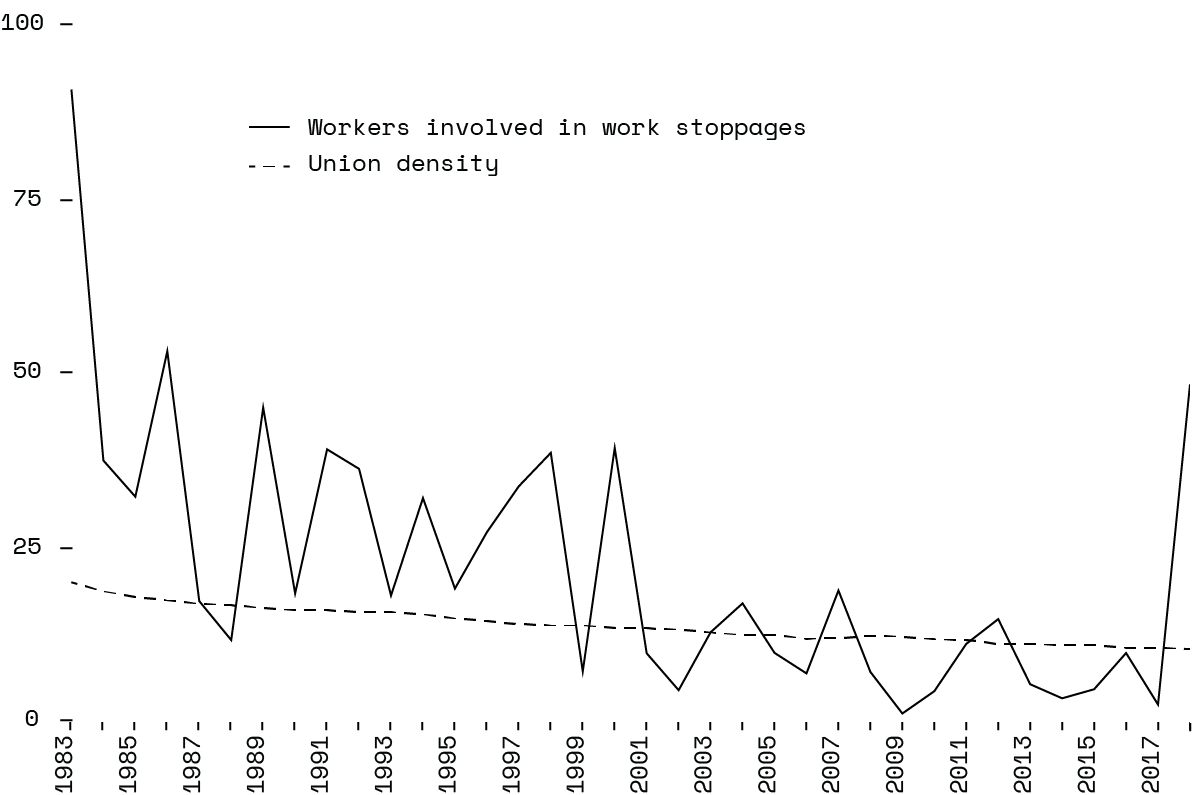
Note: Authors’ calculation. Data from the Bureau of Labor Statistics. Work stoppage figures are counted in tens of thousands, union density by percent.
While the number of unionized workers has still not begun to rebound from its decades-long decline, there is clear evidence of a positive trend in labor militancy. As Figure 13 shows, in the past three years, the number of workers involved in major work stoppages has increased fivefold, reaching a three-decade high in 2018. Though it may prove ephemeral, the recent increase in strikes we have seen — especially among teachers, but also in the hospitality and manufacturing sectors — represents the first concrete sign in recent memory that union activity could be gaining momentum. Further, more Americans have positive attitudes toward unions today than at any point since 2003 (62 percent), and more believe unions should have greater influence than at any point since Gallup began tracking the question in 1999 (39 percent).52 This suggests the organizing climate for unions is also improving. Taken together, these factors suggest that organized labor may be in a position to grow its ranks for the first time in decades. This would increase the financial resources — as well as infrastructural resources, as we discuss below — available for mobilization by a left-wing party-surrogate.
Additionally, the involvement of important sectors of organized labor in Sanders’s 2016 Democratic primary campaign suggests that more unions are willing to take a risk on outsider candidates, provided those candidates have a viable path to power and a working-class political program. Specifically, seven national labor unions representing approximately 1.25 million workers (just under 9 percent of all organized workers in the United States) backed Sanders, as did more than seventy union locals within national unions that did not endorse Sanders. There are few signs that the leadership of the largest unions, such as the NEA, SEIU, and AFSCME would seriously entertain the idea of backing insurgent candidates in Democratic Party primaries. That said, the fact that an estimated 36 percent of Democratic union members backed Sanders over Clinton — despite vocal opposition to Sanders among the leadership of the largest unions — suggests they may face increasing pressure to do so.53
In turn, by infrastructural resources, we refer to the organizational capacity of labor, progressive, and socialist organizations that would likely serve as an institutional foundation for a party-surrogate. In the absence of well-organized networks of labor and community activists, as well as electorally focused progressive and socialist organizations, the basic initial infrastructure upon which a new party-surrogate could be built would be missing.
As discussed above, the organizational capacity of labor organizations remains low, but momentum appears to be building for at least a partial resurgence of union activity in the coming years. Beyond this, though much of the post-2016 boom in progressive organization-building has proven short-lived, the extent of progressive and socialist political organizing that exists in 2019 is far beyond anything we have seen in decades. Tens, if not hundreds, of thousands of campaigners have been trained in the last three years by organizations such as Indivisible, Our Revolution, Justice Democrats, and Democratic Socialists of America (DSA). Many of these activists are or could become receptive to the idea of a party-surrogate as they encounter the limitations of an internal Democratic Party realignment strategy but remain too pragmatic to endorse a third-party strategy.54 These organizations alone could provide a sufficient initial base of organizers for a left-wing party-surrogate.
Finally, the organizational infrastructure being created by DSA has the potential to serve as the nucleus for a party-surrogate. Ballooning from a membership of some 7,500 in 2015 to more than 60,000 in 2019, DSA currently has nearly two hundred chapters across all fifty states. Further, its electoral successes have increased exponentially, from only a handful of isolated municipal and state-level officials in 2015 to dozens of elected officials around the country, including two members of Congress. Though the scale of its electoral operations remains small, to a significant extent DSA already carries out its electoral work in a manner similar to the type of party-surrogate we’re advocating. If it were able to concentrate its electoral resources more strategically in key areas of the country, develop a clear political program oriented to the broad working class (that all candidates had to accept), and cultivate a larger number of candidates from within its own activist base, there is no obvious reason why DSA could not provide the initial scaffolding for a mass party-surrogate.
A Strategic Orientation: Party-Surrogate and a Sectional Focus
Even in the face of the political opportunities described in the preceding section, democratic socialists are caught in a strategic bind. Accounting for the structural factors discussed above, exhortations to “break with” the Democratic Party seem to misunderstand the unique configurations of the major parties and the undemocratic nature of the US electoral system.55 This cut-and-run “exit” strategy reflects the third-party fetishism and wishful thinking associated with the American Green Party. The failures here are obvious and numerous.
Electoral abstention in the name of “base-building” is similarly a dead end. The far left-wing expression of this is best articulated by Mark Dudzic and Katherine Isaac in their criticism of the “organize first, build political power later” orientation.56 This perspective entirely misses the strategic opportunities offered by democratic-socialist electoral campaigns — above all, those offered by the presidential campaigns of Bernie Sanders.
On the other hand, advocates of “realignment” have routinely misunderstood the structure of the Democratic Party itself. As shown above, the party’s decentralized nature, combined with an increasingly oligarchic concentration of power within it, make the possibility of “realignment” from the inside a Herculean task.
The problem, it seems to us, is that both realignment of the Democratic Party and a break with it are not really strategies per se. Realignment and exit are, instead, potential outcomes of a successful left-wing electoral intervention. On the one hand, realignment of the party is possible, but it does not occur through electoral abstention, the capturing of state and local parties, or the singularity of presidential campaigns. Instead, a left-wing challenger can only force its politics onto the national political stage — either through or outside of one of the major parties — if it poses a credible electoral threat to one of them. The Populists, Socialists, Progressives, and numerous other third parties have successfully achieved major-party realignment — even if that was not their goal — but only when major-party elites believed they had to absorb these parties’ policies or risk serious electoral defections.57 These parties were limited to influencing major parties’ platforms (rather than challenging the parties directly) because they had no strategy for demonstrating to the electorate that they could compete seriously with one of the two major parties.
Alternatively, insurgent elements within the major parties are sometimes successful enough that they are able (or forced) to abandon the party and build a competitive third party. This was the case, for instance, with the creation of the Minnesota Farmer–Labor Party in 1921.58 Of course, insurgents always have the option of exiting the major parties, but the alternative party they build will only have a realistic chance of electoral success if it breaks away a significant portion of one of the major parties’ electoral base. Otherwise, it will lack the electoral credibility required to be competitive at the state or national level. At the national level, this has only been possible historically with the help of a popular and highly charismatic leader, Theodore Roosevelt.59
Regardless of whether a left-wing party-surrogate’s ultimate goal is realignment or exiting the Democratic Party to build a new third party, then, its success depends upon building a mass constituency among working-class nonvoters and Democratic Party voters. Given the host of structural constraints described above that limit the success of third parties in the United States, the only possible means of building a mass electoral base (other than having an extremely popular party figurehead) would be by using the Democratic Party ballot line, since this lowers the stakes of supporting insurgent candidates. After building this constituency, insurgents may be forced out of the party by the Democratic Party establishment, or the establishment may abandon the party, effectively producing realignment. These outcomes depend on a range of contingent political factors and cannot be predicted in advance. The key point to bear in mind is that these are not strategies for building a mass working-class party. Instead, they are the potential outcomes of such a strategy.
The fundamental question for a democratic-socialist electoral strategy to answer is how a left-wing party-surrogate can organize a constituency with sufficient influence in US politics that it poses a credible electoral threat to the Democratic Party establishment without succumbing to inevitable pressures to sacrifice its political platform in the name of tactical expedience. A successful strategy has to address the medium-term obstacles listed above through both strong organization-building and a strategy for maximizing electoral gains. To do this successfully, democratic socialists must (1) establish a party-surrogate that is capable of insulating candidates from the incentive structures of the major parties through mass mobilization, and (2) strategically mobilize voters through a “sectional” concentration of political efforts.
Party-Surrogate
By adopting the Democratic Party ballot line, a party-surrogate can effectively sidestep many of the legal obstacles to party competition and access a much-needed mass constituency. Yet this alone is not enough. An effective surrogate must also mitigate the challenges associated with both the incentive structures of the Democratic Party and the power of money. We have seen how both obstacles effectively discipline progressive candidates upward and rightward. What is needed, then, is an organization that is able to maintain its autonomy from these incentives and offer candidates a shelter from the Democratic Party while using the ballot line to access a mass constituency.
First, unlike mainstream-party candidates, who must rely on money and name recognition to build a constituency, candidates of the party-surrogate would have access to a robust volunteer base mobilized on behalf of their campaigns. Rather than hitching their campaigns and platforms to higher officeholders sponsored by the party elite, party-surrogate candidates can be assured of an organized voter mobilization arm dedicated to advancing the goals of the organization itself. This advantage would allow candidates who remain faithful to the surrogate’s policy platform to enjoy the kind of voter mobilization outfit once offered by major political machines and industrial unions.
Second, a party-surrogate would greatly reduce the power of money through the mass mobilization of voters. Candidates would have fewer incentives to rely on big-money donors or the DCCC precisely because campaign cash is used most often to buy what an externally mobilized party-surrogate provides: committed campaign workers. Thus, freed from the pressure to raise exorbitant amounts of cash, candidates would be better able to pursue the policy platform advanced by their party-surrogate over and above that advanced by the donor class. In turn, candidates’ dependence on this mobilization machine could reverse the incentives provided by money and force candidates to hew closer to the policy platform of the party-surrogate in order to secure the surrogate’s support.
Accessing these organizational advantages alone, however, is not sufficient for electoral success. The capacity of a strong ground game to overcome financial disadvantages decreases considerably at higher levels of government where the role of television and internet advertising becomes more critical to success. This means the party surrogate would have to find a path to victory in contexts where its mobilizational capacity is not a silver bullet. Additionally, while using the Democratic Party ballot line partially resolves the spoiler problem by allowing voters to express their true preferences in the primary rather than the general election (where the stakes of victory are much higher), it does not do so entirely. Voters will still be quite skeptical of insurgent candidates, even when they run on the Democratic Party ballot line. Consequently, a left-wing party-surrogate requires a strategy for building electoral credibility from a position of relative political weakness.
To address these problems, the surrogate must develop a strategy that initially concentrates its electoral efforts on specific regions of the country where it can become a political force as powerful as one of the two major parties (in terms of both numbers of elected officials and support among the electorate). In turn, it can use its success in these areas to demonstrate its electoral viability in other regions of the country.
A Sectional Focus
A party-surrogate will struggle to win elections and execute even a modest political program if it conceives of its immediate scope in national terms. This is due primarily to the nature of our first-past-the-post, single-member district electoral system at the national, state, and (in many cases) local levels. Specifically, candidates will fear that committing to the party-surrogate in order to win the Democratic Party nomination could undermine their viability in the general election, and voters will worry that the surrogate’s candidates are too inexperienced or too radical to ensure Republican defeat in the general election. These problems can be partially overcome in areas with single-party dominance — in places where the winner of the Democratic primary is virtually guaranteed to win in the general election. Even in these areas, however, candidates may fear that committing to the party-surrogate might unduly tie their hands once in office and potentially undermine their reelection prospects. Further, voters may be concerned that party-surrogate candidates will be politically isolated in office and incapable of delivering for their home constituency.60
A surrogate, then, must find a way to convince strong candidates that it represents a credible path to electoral success, while assuring voters that it can be competitive and perform well in office. At best, an indiscriminate nationwide approach could yield a small number of isolated victories here and there. This will hardly be sufficient to show skeptical voters that the organization is a serious electoral vehicle with the capacity to represent anything beyond electoral anomalies, or that it can deliver material reforms in a way mainstream Democrats cannot. Suppose the organization has the capacity to put significant resources behind twenty candidates. If those candidates are spread across twenty states, this would yield at most marginal influence in a handful of municipalities across those states, and almost no name recognition or loyal voter base across any state. The Green Party is a case in point: it currently has city councilors in eleven states,61 but it does not have more than four in any state, and in no state does it have city councilors in more than three municipalities. As a result, the Green Party has virtually no stronghold in any state, and it has been unable to demonstrate its capacity to govern or carry out its platform in any municipality.62 Together, these factors all but ensure the party will not be viewed as a viable electoral alternative to the two main parties by more than a small handful of core supporters.
However, if the party-surrogate concentrated its electoral efforts, at least initially, on a particular region of the country rather than allocate its resources in an ad hoc manner around the country, it could overcome the credibility problems discussed above. Say, for example, a party-surrogate focused on twenty candidates in three adjacent states. This could dramatically increase the density of the group’s elected officials. Rather than having a single official in twenty states across the country, it could have six or seven officials across three states in the same region. This sectional strategy helps the party-surrogate further mitigate structural barriers to success and take advantage of a number of opportunities.
First, sectional concentration could (1) mitigate the disadvantages of single-member districts by exploiting geographic concentration, and (2) have a greater impact on the politics of the municipalities and state legislatures by increasing the density of elected officials. Because the structure of single-member districts places a premium on geographic concentration, any party-surrogate has a greater chance of increasing their success through the regional concentration of its political efforts.63 Further, these election victories, when concentrated, offer greater benefits than when scattered. Put another way, a sectional concentration can turn the national disadvantage of the single-member district system into a regional advantage for a small party-surrogate. Because this system over-rewards the winners of political contests, a geographic concentration of campaigns could result in significantly more political victories than national-level strength — determined by vote share — would otherwise predict. As a result, geographic concentration could more quickly result in the establishment of a large minority (or even a majority) on a given city council or a state legislature. Such sectional concentration in government provides far more political leverage over a given locale than having the same number of elected officials segregated among a handful of local governments. This is critical because an electoral organization’s reputation among voters is based to a significant degree on its performance in office.64 Principled stances against politics as usual by a lone independent city councilor or state representative simply don’t have the capacity to generate the same reputation as, for example, building a majority coalition within city council to increase the number of affordable housing units and implement a living-wage ordinance.65
Second, a regional concentration can help build a political identity. As mentioned above, the great retreat of the political machine left a large hole in the patterns of working-class political life. While machines were often politically corrosive, and corruption hampered any benefits these organizations wrought, they nonetheless helped organize working-class political claims and mobilized these voters into the political system. With their decline, working-class voters no longer had an easily identifiable local political organization that could provide this function. Today, a party-surrogate could fill this space without any real competitors and absent the objections of a local boss. A regional concentration can help the party-surrogate build an identifiable political profile and, if successful, it can generate a positive feedback loop among electoral success, name recognition, and electoral credibility. With each victory, more voters are exposed to the surrogate and its program for the first time, and more view it as a legitimate political alternative. Over time, this feedback loop can increase competitiveness in more races across the state, as well as at higher levels of office in the state. The experience of the Vermont Progressive Party is instructive here. Eventually, the party-surrogate can become a political force in the state, matching the power of the two major parties. Similarly, a sectional strategy can help demonstrate to voters in nearby states what an effective surrogate can do politically, and these voters will be more likely to take its candidates seriously in their own state.66
Third, regional concentrations also allow party-surrogates to take advantage of our federated system by implementing reforms at the state level that can serve as signals of the party’s intentions at higher levels of government and as evidence of its capacity to govern. Crucially, this approach allows party-surrogates to overcome many of the structural biases stacked against third parties through a regional ratcheting process where these limitations are first addressed within a few municipalities in a particular state, and in turn the success of these efforts allows the organization to overcome analogous difficulties in other municipalities as well as at the state level.
Finally, a regional concentration helps to maximize the organization’s strengths, in particular the power of its volunteer army. As we have seen above, the most important way to mitigate the influence of money and to increase candidates’ dependence on the party-surrogate is through maximizing the leverage of the surrogate’s mobilizational base. By concentrating resources in select regions, the organization’s members in neighboring states and municipalities can campaign across a given region in a more concerted fashion than if the organization were to divide its resources equally across races nationwide, or if local affiliates were left on their own to coordinate expensive and labor-intensive campaigns.
The sectional approach described here could be successful precisely because it would generate a political heartland for the party-surrogate. The development of such a heartland would allow for less labor-intensive cross-campaigning among party-surrogate members, voters, and candidates — it’s easier for campaigners to mobilize members and voters in a given region than across a continent. Further, the heartland effect bolsters the insulation effect of the party-surrogate. Such a strategy, it should be noted, is not only advantageous in the United States, or even in the contemporary moment, it is in fact the genesis of almost all successful efforts of working-class party-building in duopolistic political systems.67 Indeed, the UK Labour Party found its heartland in Northern England and the provincial midlands and built out its support to eventually displace the Liberal Party, while the Australian Labor Party initially relied on its concentration in New South Wales to do the same.68
More recent examples include the consolidation of the Workers’ Party (PT) in Brazil. For the first two cycles of municipal elections in which it competed (1988 and 1992), the PT elected more mayors in one region of the country (the Southeast, particularly in the states of São Paulo and Minas Gerais) than in the rest of the country combined. In 1996 and 2000, the party significantly expanded into the Southern region, particularly the state of Rio Grande do Sul, but it wasn’t until after Lula’s election as president in 2002 that the party significantly expanded beyond these regions, particularly to the Northeast.69 The brief success of the New Democratic Party (NDP) in Canada is also instructive. Operating under electoral constraints similar to the United States, the NDP was able to develop a regional concentration in the western provinces of Canada, which helped it to overcome the constraints it faced competing in national-level politics. These examples and others demonstrate that, as mass mobilization has been the major strategy for externally mobilized working-class parties, its success depends chiefly on maximizing the mobilizational capacities of the party in formation. The best means of doing so, especially in duopolistic political systems, is through a concentration of efforts to establish a regional heartland.
Caution and Conclusion
The challenge of American democratic socialists is to build working-class political strength absent a mass working-class party. What’s more, given the nature of the American government, we lack even the basic parliamentary structures that Marxists from Kautsky through Poulantzas identified as a precondition for the democratic road to socialism.70 Nonetheless, if we are to succeed, we must intervene seriously in electoral politics. Electoral abstention is not an option and will only serve to delay and defer confronting the immense challenge before us.
The analysis and strategy presented here provide a medium-term road to building a party-surrogate and a mass working-class constituency for democratic-socialist politics. It is important to note, however, that ours is not a strategy for broader democratic-socialist political success (i.e., some kind of socialist transition). Indeed, it is not clear how successful such a party-surrogate could be in winning elections before it ran up against insuperable funding barriers and constraints imposed by the imperatives of managing a capitalist economy. This is why we call ours a strategy for competing and not necessarily a road to victory. Instead, we limit ourselves to the still massive but relatively more modest question of democratic-socialist electoral strategy, grounded in an institutional and political-economic analysis of the structure of American politics and opportunities presented by the growth of an unaligned working-class constituency.
Revisiting the caveats raised in our introduction, we would like to note that absent the complementary associational power of the working class on the shop floor and a militant and powerful reform movement, the pressures facing the candidates of a party-surrogate — even if successful in their pursuit of a majority government — would be immense.71 The structural power of capital combined with the instrumental imperatives of democratic competition ensure that even under optimal conditions the chances of success are low. The task of building working-class political power strong enough to challenge and defeat one of the most entrenched and powerful ruling classes in world history is among the more daunting political projects ever attempted. That is, we must be prepared for failure. As democratic socialists, however, we have no choice but to try.